
In modern architecture, small details often create the strongest impression. One of these details is the aluminum shadow gap profile. It has become a key element in minimalist interior design. It changes how walls, ceilings, and floors meet each other.
For global B2B buyers – architects, contractors, developers, and procurement teams – understanding shadow gap profiles is essential. You need to know the technical side, the practical use, and how to source them. That way you can deliver high‑value projects on time and within budget.
This guide draws on over 21 years of aluminum extrusion experience at BRILLIANCE. We are a trusted manufacturer with supply chains in Guangdong and Shanghai. Whether you are sourcing for a luxury hotel chain, a commercial office tower, or a high‑end residential development, this article will help you make smart, cost‑effective decisions.
1. What Is a Shadow Gap Aluminum Profile? Definition & Core Value
A shadow gap is a small recess where two building surfaces meet – for example, wall to ceiling, wall to floor, or wall to door frame. Instead of a sticking‑out trim or baseboard, a shadow gap creates a clean, dark line. This makes the nearby surface look like it is “floating.”
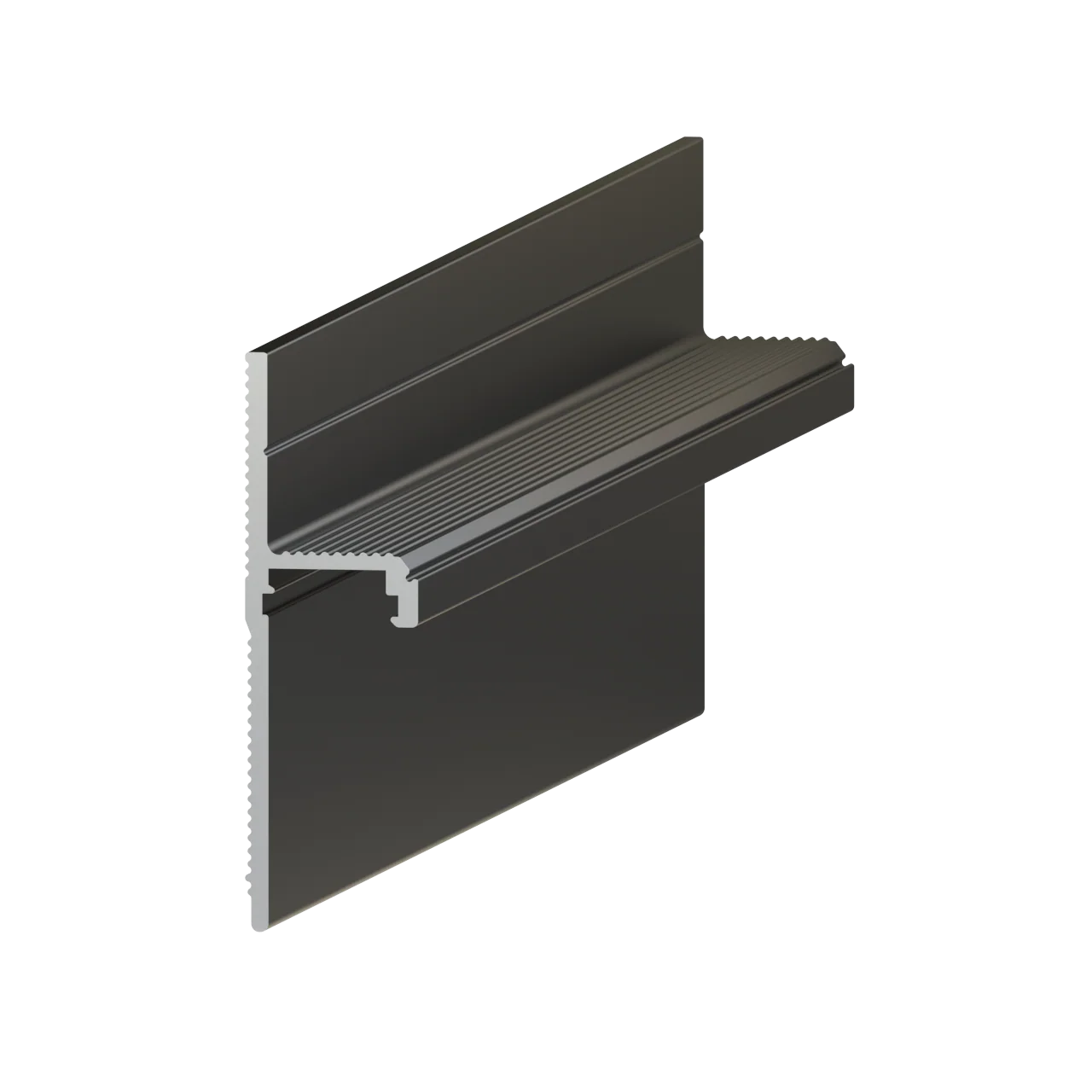
An aluminum shadow gap profile is a precision‑extruded aluminum strip. You install it flush with drywall or plasterboard. It forms a consistent gap, usually 2.5 mm to 20 mm wide. The profile works both as a guide for installers and as a permanent architectural detail.
Why aluminum? Aluminum gives you superior strength, stable dimensions, corrosion resistance, and a premium finish. PVC, wood, or MDF cannot match that. For B2B buyers, this means fewer callbacks, a longer service life, and higher perceived value for the end client.
At BRILLIANCE, we have made aluminum profiles for more than two decades. Our shadow gap profiles use 6063‑T5 alloy. We offer many standard sizes and also fully custom cross‑sections. We know that every project has unique needs – our job is to meet them precisely.
2. Key Benefits for B2B Buyers & Project Stakeholders
When you buy or specify shadow gap aluminum profiles, you get more than just a trim piece. Here are the measurable benefits from a business point of view.
| Stakeholder | Benefit |
|---|---|
| Architect / Designer | Get a true minimalist “floating” look without visible joints or bulky transitions. |
| General Contractor | Profiles act as built‑in guides. They reduce drywall finishing time and give perfectly straight lines. |
| Procurement Manager | Enjoy consistent quality, reliable lead times, and volume pricing from an experienced supplier. |
| End Client (Hotel/Office/Residential) | Get a durable, low‑maintenance detail that keeps its crisp look for decades. |
More advantages:
– Fire safety – Aluminum does not burn (Class A). This is critical for commercial buildings.
– Moisture resistance – No swelling, rotting, or termite damage. Works well even in bathrooms or coastal projects.
– LED integration – Many profiles can hold LED strips. This creates “glow lines” for ambient lighting.
– Easy maintenance – Smooth surfaces resist dust and are simple to clean.
3. Technical Specifications: What to Look For
Global B2B buyers need clear, comparable technical data. Below are the industry‑standard specifications for high‑quality shadow gap aluminum profiles.
| Parameter | Standard Offering | Notes |
|---|---|---|
| Material | 6063‑T5 aluminum alloy | Best mix of extrudability, strength, and surface finish |
| Gap width | 2.5 / 3 / 4 / 5 / 6 / 8 / 10 / 12 / 15 / 20 mm | Wider gaps give a stronger shadow effect |
| Profile length | 2.0 m, 2.5 m, 3.0 m | Custom lengths up to 6 m available |
| Wall thickness | 0.8 mm – 1.2 mm | 1.2 mm is best for high‑traffic commercial use |
| Surface finish | Powder coating (RAL), anodized (silver/gold/black), mill finish | Powder coating gives unlimited colors; anodizing gives a metallic sheen |
| Dimensional tolerance | ±0.05 mm | Ensures consistent shadow lines across long runs |
| Corrosion resistance | ≥500 h salt spray (ASTM B117) | Verified by third‑party testing |
| Certifications | ISO 9001, RoHS, REACH | Compliance with major international standards |
BRILLIANCE keeps strict in‑house quality control. We use spectral analysis to check alloy composition and continuously gauge profiles. We provide test reports with every shipment on request.
4. Types of Shadow Gap Aluminum Profiles (With Application Guide)
Not all shadow gap profiles are the same. The right type depends on where you install it and what look you want.
A. F‑Profile (Standard Wall & Ceiling)
Shape: Looks like the letter “F”. A long leg attaches to the wall, and a shorter leg defines the shadow gap.
Application: Where drywall meets drywall, or drywall meets ceiling.
Recommended gap: 6–10 mm.
Most common choice for general interiors.
B. L‑Profile / Shadow Wall Angle
Shape: Simple 90° angle, like corner bead but with an extended wing.
Application: Internal wall corners, ceiling perimeters, or as a minimalist skirting.
Recommended gap: 3–8 mm.
Ideal for shadow lines at corners without visible miter cuts.
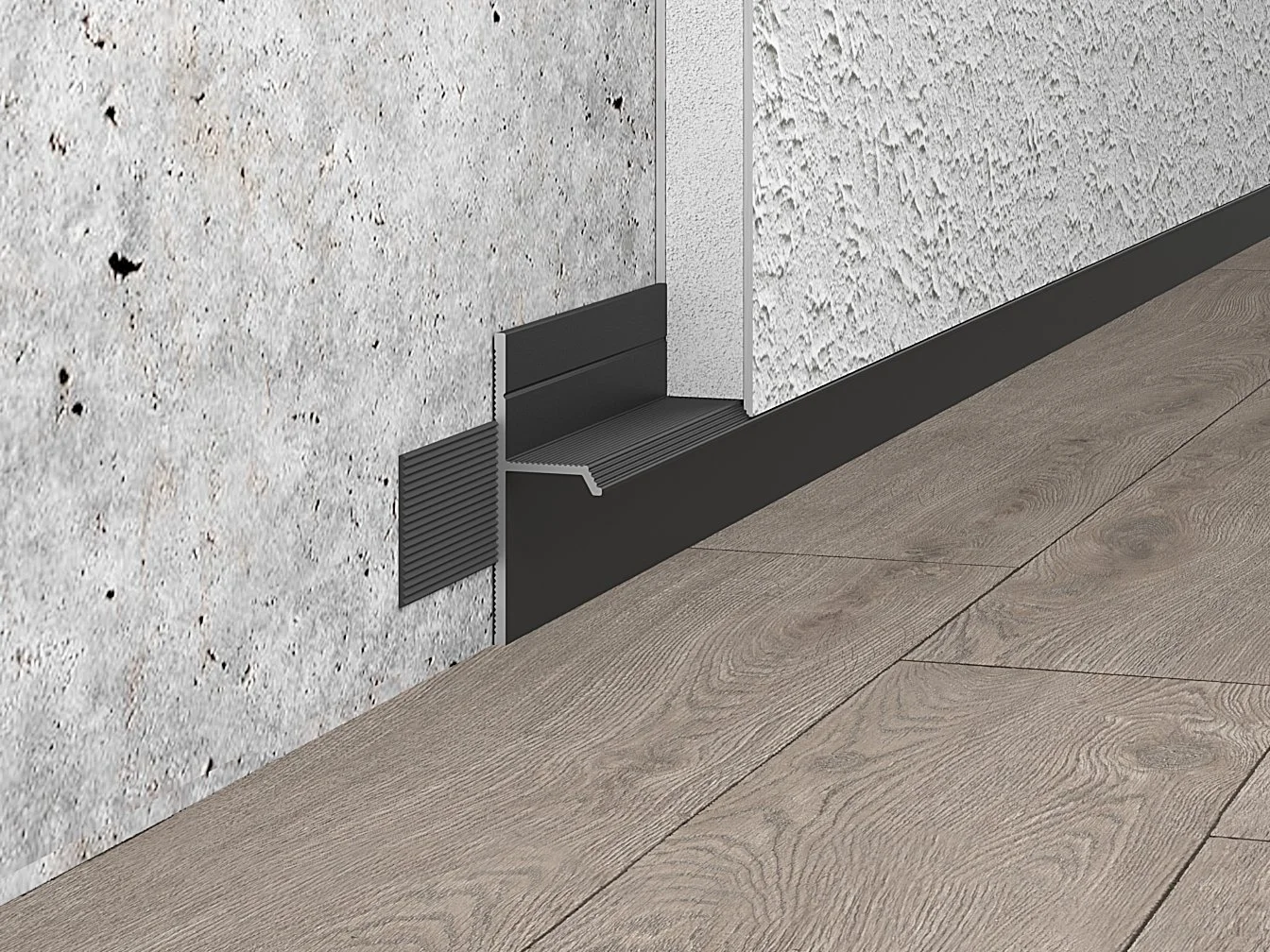
C. Shadow Gap Skirting (Baseboard Replacement)
Shape: L‑profile with a taller vertical leg that goes up from the floor.
Application: Replaces traditional baseboards. The gap is at the top of the skirting.
Recommended gap: 10–15 mm.
Benefit: No dust‑collecting ledges; walls look like they float above the floor.
D. LED‑Integrated Shadow Gap Profile
Shape: U‑channel with a recessed cavity (usually 8–12 mm wide) for an LED strip.
Application: Floating ceilings, cove lighting, accent walls, corridor lighting.
Diffuser options: Opal or transparent cover for even light distribution.
Trending: The most requested profile for hotel guest rooms and luxury retail in 2025–2026.
E. Door / Window Frame Shadow Gap
Shape: Asymmetric L‑profile or a special jamb profile.
Application: Trimless door and window openings where the frame sits flush with the wall.
Recommended gap: 5–10 mm.
Result: A clean, uninterrupted wall surface around openings.
BRILLIANCE offers all these profile types in standard sizes. In addition, our in‑house mold‑making team can produce any custom cross‑section based on your CAD drawing or physical sample – usually within 10–15 days. Learn more about our Customized Processing Service.
5. Aluminum vs. PVC vs. Traditional Trim: A B2B Comparison
This side‑by‑side comparison shows why aluminum gives the best value.
| Factor | Aluminum Shadow Gap | PVC Shadow Gap | Wood / MDF Trim |
|---|---|---|---|
| Visual quality | Sharp, crisp, premium | Clean but can look “plasticky” | Warm but not truly floating |
| Durability | 20+ years, no degradation | 5–10 years, UV brittleness | 3–8 years, prone to rot/warp |
| Fire rating | Class A (non‑combustible) | Class C (combustible) | Class C (combustible) |
| Moisture resistance | Excellent | Good | Poor |
| Dimensional stability | ±0.05 mm | Moderate (expands/contracts) | Low (swells) |
| Customization | Unlimited (any color, any shape) | Limited shapes/colors | Moderate (but no true shadow gap) |
| Installation skill required | Medium–high | Low | Medium |
| Typical FOB price (per meter) | $0.80 – $2.80 | $0.50 – $1.20 | $1.00 – $3.00 (plus finishing) |
B2B Verdict: For projects where longevity, looks, and fire safety matter – hotels, hospitals, offices, luxury apartments – aluminum shadow gap profiles give you the lowest total cost of ownership. The upfront price is slightly higher than PVC, but you save money over time.
6. How to Install Aluminum Shadow Gap Profiles: A Step‑by‑Step Guide
Good installation is critical. Even the best profile will not give a clean shadow line if the wall is uneven or the profile is misaligned.
Tools needed: Laser level, aluminum‑cutting saw, construction adhesive, stainless steel screws (Φ3 mm), rubber mallet, corner connectors.
Step‑by‑step procedure:
1. Mark the reference line – Use a laser level to draw a continuous horizontal line around the room at the height you want. For skirting, that is about 10 mm above the finished floor. For a floating ceiling, it is flush with the ceiling.
2. Apply adhesive and fix the profile – Run a continuous bead of construction adhesive on the back of the profile. Press the profile against the wall or ceiling along the laser line. For extra strength, drive stainless steel screws every 30 cm into studs or solid backing. See our Cutting and Drilling guides for prep work.
3. Check for level and straightness – After each 2‑meter section, check with the laser level. Maximum allowed deviation: 1 mm per meter. Adjust before the adhesive sets.
4. Install drywall/plasterboard – Butt the drywall edge exactly against the profile’s reveal leg. Do not overlap or underlap. The profile design already sets the gap width.
5. Handle corners – For internal corners, use a 45° miter cut or a prefabricated corner connector. For external corners, use a dedicated corner profile to keep a continuous shadow line. Bending may be needed for curved walls.
6. Finish and paint – Apply joint compound to drywall seams. Before painting, mask the aluminum profile with painter’s tape. After painting, remove the tape to reveal the clean shadow gap.
Common mistakes to avoid:
– Installing on uneven walls without leveling first.
– Using carbon steel screws (they rust and bleed through paint).
– Skipping corner connectors, which makes shadow lines misaligned at corners.
– Plastering over the aluminum profile instead of masking it.
BRILLIANCE provides illustrated installation manuals. We can also arrange virtual or on‑site technical support for large projects. We have helped contractors in more than 30 countries get flawless installations.
7. LED‑Integrated Shadow Gap Profiles: The Fastest‑Growing Segment
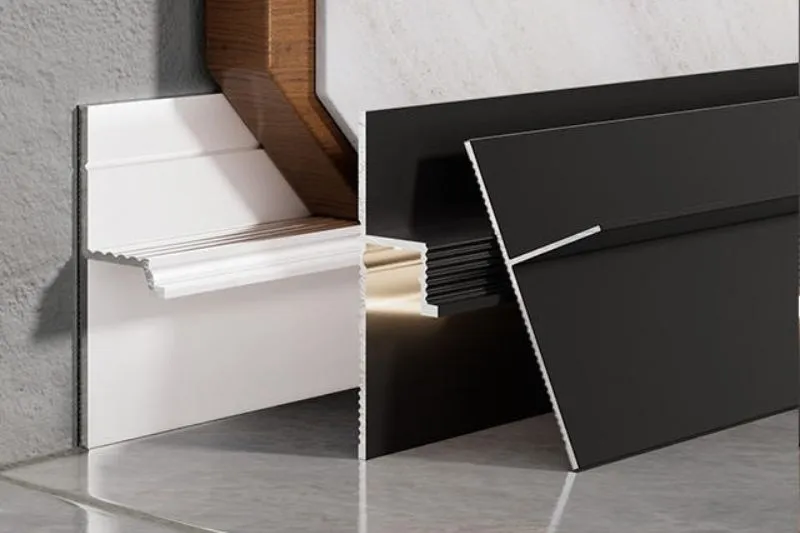
Indirect lighting is now a defining feature of modern interiors. LED‑integrated shadow gap profiles combine the floating effect with functional or ambient light.
How it works: The profile includes a U‑shaped channel behind the shadow gap. You place an LED strip (usually 8–12 mm wide, 24V) inside the channel. An optional opal diffuser softens the light and protects the LEDs.
Popular applications:
– Floating ceilings – A shadow gap around the whole ceiling perimeter with warm white LEDs gives a “sky glow” effect.
– Hotel headboard walls – A vertical shadow gap on each side of the bed, lit up, works as a modern alternative to bedside lamps.
– Retail display walls – Adjustable color temperature LEDs highlight products while keeping clean lines.
– Corridor wayfinding – Continuous linear light at the base of walls in hotels or office corridors.
Technical points for B2B buyers:
– Make sure the profile has good heat dissipation (aluminum naturally acts as a heat sink).
– Confirm LED strip compatibility (voltage, width, connector type).
– Ask for samples to check light uniformity with the diffuser on.
BRILLIANCE offers a dedicated LED‑shadow gap line with optimized channel geometry. We can also pre‑cut profiles to your exact project lengths and supply matching LED kits on request.
8. Global Applications & Commercial Project Examples
Knowing where shadow gap profiles are used helps you find market opportunities and specify the right product.
| Project Type | Typical Use | Recommended Profile |
|---|---|---|
| 5‑star hotels | Guest room ceilings, corridor skirting, bathroom wall transitions | LED‑integrated (8‑10 mm gap), powder coated RAL 9010 |
| Corporate headquarters | Floating reception ceilings, glass partition wall transitions | F‑profile (6 mm gap), anodized satin silver |
| Luxury residential towers | Baseboard replacement, door trimless openings, ceiling perimeters | Shadow gap skirting (12‑15 mm gap), custom RAL |
| High‑end retail stores | Display wall shadow lines, product alcove detailing | LED‑integrated (variable gap), black powder coating |
| Hospitals & clinics | Hygienic wall‑to‑floor transitions (reduces dust traps) | Shadow gap skirting with antimicrobial coating |
| Museums & galleries | Baseboard‑free walls for uninterrupted display surfaces | L‑profile (6 mm gap), matte white |
Regional demand patterns: Europe (especially Germany, UK, Poland) and North America are mature markets with high specifications. The Middle East (UAE, Saudi Arabia) and Australia are growing fast, driven by luxury hospitality and residential construction. Check our Application Cases for real project examples.
9. Sourcing from China: A Strategic Guide for Global Buyers
China is still the world’s most competitive aluminum extrusion hub. You get short lead times, wide customization options, and cost advantages. But choosing the right supplier is very important.
Why source from China?
– Mature extrusion industry with decades of expertise.
– Vertical integration (from billet casting to surface finishing) cuts lead times.
– Fast mold development (7–15 days for new profiles).
– Well‑established export documentation and logistics.
What to look for in a supplier:
– Experience – Prefer suppliers with 10+ years in export business.
– Certifications – ISO 9001, RoHS, REACH, and optionally BSCI.
– In‑house mold making – Faster changes and lower costs.
– Quality control – Ask for material certificates and salt spray test reports.
– Communication – Responsive technical support in English.
Typical order parameters (for reference):
– MOQ (standard profiles, standard colors): 3,000 – 5,000 meters
– MOQ (custom profiles or custom RAL colors): 10,000 meters or mold fee applies
– Sample lead time: 7–15 days (including mold making if custom)
– Mass production lead time: 20–30 days
– Sea freight (China to Europe/US): 30–45 days door‑to‑door
Indicative pricing (FOB China, 2026):
– Standard F‑profile (6 mm gap), powder coated RAL 9010: $0.90 – $1.40 per meter
– LED‑integrated profile, anodized: $1.60 – $2.50 per meter
– Custom cross‑section, any RAL color: +$0.30 – $0.70 per meter (volume dependent)
BRILLIANCE, with over 21 years of continuous operation, has perfected every part of the export process. Our plants in Guangdong (the heart of China’s aluminum extrusion industry) and Shanghai (a major international port) give us manufacturing excellence and logistics efficiency. We currently serve B2B clients in more than 30 countries across Europe, North America, the Middle East, and Asia‑Pacific. Learn about our Agency Policy if you are interested in becoming a distributor.
10. Customization & OEM/ODM Services
Off‑the‑shelf profiles work for many projects. But signature buildings often need unique dimensions, shapes, or finishes.
BRILLIANCE’s customization capabilities include:
– Cross‑sectional geometry – Based on your CAD drawing, sketch, or physical sample.
– Gap width – Any size from 2 mm to 25 mm, in 0.5 mm steps.
– Length – Up to 6 meters per piece (longer on request).
– Wall thickness – From 0.6 mm to 2.0 mm.
– Surface finish – Any RAL color, anodizing grade (Class I or II), brushed, polished, or wood grain. Also electrophoresis and PVDF.
– Packaging – Custom labels, bundle quantities, shrink‑wrap, wooden crates.
– Secondary operations – Cutting, drilling, punching, CNC machining, bending, welding.
OEM/ODM process:
1. Customer shares requirements (drawing or sample).
2. Engineering review (24 hours).
3. Mold design & manufacturing (7–10 days).
4. Sample extrusion & inspection (3–5 days).
5. Customer approval.
6. Mass production (20–30 days).
7. Quality control & shipment.
“We don’t just extrude aluminum – we solve design challenges.” Our engineering team has successfully delivered custom shadow gap profiles for projects ranging from boutique hotel lobbies to international airport terminals. See our Video Page and Product Documentation Download Page for more details.
11. Frequently Asked Questions (B2B Focus)
Q1: What aluminum alloy is best for shadow gap profiles?
A: 6063‑T5 is the industry standard. It gives excellent extrudability, a smooth surface for finishing, and good mechanical properties (yield strength ≥160 MPa).
Q2: Can you match a specific RAL color?
A: Yes. We powder coat in over 200 RAL colors, including RAL 9010 (pure white), RAL 9005 (jet black), RAL 7042 (traffic grey), and many others. We also offer custom color matching. Read about our Multiple Surface Treatment Processes.
Q3: Do you provide samples before mass production?
A: Absolutely. Sample fees apply (covering material and shipping), but they are fully refundable when you confirm a mass order. Use our Sample Acquisition Message to request samples.
Q4: What is your typical MOQ?
A: For standard profiles in common RAL colors, MOQ is 5,000 meters. For smaller trial orders, please contact us – we are flexible for serious buyers.
Q5: How long does mold development take for a custom profile?
A: Typically 7–10 days for mold manufacturing, plus 3–5 days for sample extrusion. Total sample lead time: 10–15 days.
Q6: Are your profiles suitable for exterior use?
A: Yes, with the right surface treatment (Class II anodizing or high‑durability powder coating). For exterior use, we recommend a minimum wall thickness of 1.2 mm and sealing all joints.
Q7: What certifications do your products carry?
A: Our facilities are ISO 9001:2015 certified. Products comply with RoHS and REACH standards. We can arrange additional certifications (e.g., CE, UKCA) based on your destination country.
Q8: How do you ensure consistent quality across large orders?
A: We use inline profile gauging, random sampling during extrusion, and 100% visual inspection before packaging. Third‑party inspections (e.g., SGS, BV) are welcome at the buyer’s expense.
Q9: What is your lead time for a 20‑foot container order?
A: For standard profiles in stock colors, 20–25 days after order confirmation. For custom profiles, 25–35 days (including mold making and sample approval).
Q10: Can you supply profiles longer than 3 meters?
A: Yes, up to 6 meters. Longer lengths may need special packaging and increase sea freight costs. Our logistics team will advise you.
12. Why BRILLIANCE Is Your Trusted Partner for Shadow Gap Aluminum Profiles
For over 21 years, BRILLIANCE has built a reputation as a reliable, high‑quality aluminum extrusion manufacturer serving global B2B clients. Our product range goes far beyond shadow gap profiles. We make architectural profiles, industrial extrusions, T‑slot and V‑slot profiles, marine profiles, aerospace components, medical aluminum profiles, 3C/5G profiles, shower enclosure profiles, tile trim profiles, whiteboard frames, furniture and cabinet profiles, tent profiles, automotive and bicycle profiles, machinery profiles, solar mounting structures, curtain wall profiles, curtain rod profiles, and many more.
What makes us different:
– 21+ years of hands‑on experience – We have seen – and solved – almost every extrusion challenge.
– Dual manufacturing hubs – Facilities in Guangdong (extrusion hub) and Shanghai (export hub) give us supply chain strength and logistics advantages.
– In‑house mold making – Faster turnaround and lower costs for custom profiles.
– End‑to‑end service – From alloy selection and extrusion to surface finishing and packaging, all under one roof. Check our End-to-End Service & Guarantee System.
– Global export track record – Happy B2B customers in Europe, North America, the Middle East, Southeast Asia, and Australia.
– Commitment to quality – Every profile meets strict standards for strength, dimensional accuracy, and surface durability.
Our philosophy: “We provide not just products, but solutions. Your project’s success is our success.”
13. Ready to Source? Get Your Tailored Quote Today
Every project is unique, and so is every quotation. To get an accurate, no‑obligation quote for your shadow gap aluminum profile needs, please give us the following information:
– Project type and estimated total length (meters)
– Preferred gap width (e.g., 6 mm, 10 mm)
– Profile type (F‑profile, L‑profile, LED‑integrated, custom)
– Desired surface finish (RAL color code or anodizing)
– Destination port (for freight calculation)
Contact BRILLIANCE now:
📧 Email: [email protected]
🌐 Website: https://hhalum.com/aluminum-profiles/
Our technical sales team responds within 24 hours. For urgent inquiries or large‑scale projects, we can arrange a video call to walk you through our facilities and quality control processes. Download our Latest Catalogue for full product details.
Choose BRILLIANCE aluminum profiles. Let your next project rise on innovation and reliability.
Published: April 2026 | Last updated: April 2026